
From Textbooks to Hallowed Ground: Trip Leads Lander Students to Civil Rights History
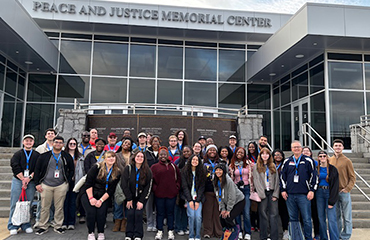
A group of 37 Lander University students and faculty visited civil rights historic sites in Selma and Montgomery, Alabama, over the holiday break. Contributed Photo.
It would be impossible to visit historic civil rights sites in Selma and Montgomery, Alabama, without being deeply moved.
For 37 Lander University students and faculty, who joined a larger community group totaling 107 people, the trip placed them in locations of the Civil Rights Trail, considered by many to be hallowed ground, where moments of profound courage and tragic injustice shaped the course of American history. The Lander students were led by Dr. Kevin Witherspoon, a Lander University history professor and Dr. Benjamin E. Mays Endowed Chair, and faculty members Drs. Brian Pitman, John Moore and James Romaine from Lander’s College of Humanities, Arts and Social Sciences.
Witherspoon coordinated the trip with Chris Thomas, director of the Benjamin Mays Site, and Lander benefactor the Rev. Doug Kauffmann, who created the Dr. Benjamin E. Mays Endowed Chair in 2020, along with late wife, Sally Kauffmann.
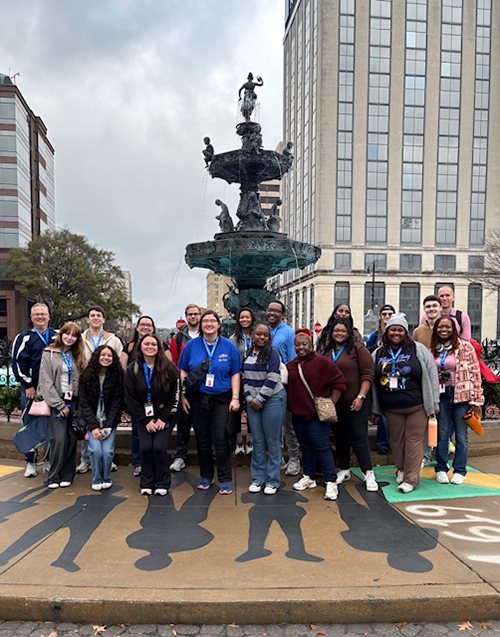
Lander students recently visited the Court Square Fountain in Montgomery, Alabama, where civil rights icon Rosa Parks was arrested in 1955 – an act that led to the Montgomery Bus Boycott. Contributed Photo.
Among the sites visited were the Edmund Pettus Bridge in Selma, where voting rights marchers were confronted by law enforcement on March 7, 1965, and the Alabama State Capitol Building in Montgomery. The focal point of the trip was a thorough journey to all three components of the Equal Justice Initiative complex: the Legacy Museum, the National Memorial for Peace and Justice, also known as the “lynching memorial,” and the Freedom Monument Sculpture Park.
“It was a profound and moving experience for everyone,” Witherspoon said. “Walking across the Edmund Pettus Bridge and standing inside Dexter Avenue Baptist Church, where Dr. Martin Luther King Jr. once preached, evokes emotions that cannot be replicated in a classroom or textbook.”
In addition to these historic landmarks, students experienced the powerful storytelling of museums designed to immerse visitors in the realities of the Civil Rights Movement. “The Equal Justice Initiative’s Legacy Museum left a particularly lasting impression, using striking sculptures, historic photographs, news clippings, soundscapes and lighting to engage multiple senses,” Witherspoon said.
“First-person accounts, film presentations and lifelike holographic recreations transported students back in time, offering an unflinching look at America’s past. The Rosa Parks Museum provided similarly impactful exhibits, reinforcing the human stories behind the movement,” he said.
The experience allowed students to learn -- and feel -- far more in a few days than would be possible through weeks of traditional study alone, Witherspoon said.
“Throughout the trip, students were reminded of the sacrifices made by previous generations to secure the rights and freedoms enjoyed today, and of the responsibility to protect those rights as the nation moves forward,” he said.
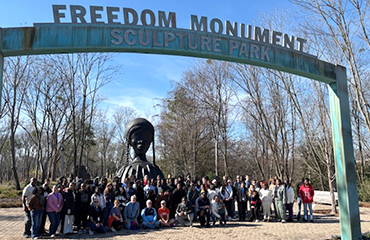
Reading about the Civil Rights Movement in textbooks or watching documentaries can only go so far, said Lander student Parker Kauffman, of Summerville.
“Being physically present in these places made the history feel real in a way I was not prepared for. Walking across the Edmund Pettus Bridge, standing inside Dexter Avenue Baptist Church, and seeing my home of Dorchester County, South Carolina, listed at the lynching memorial forced me to reflect deeply on the history of the United States and how closely it is tied to the present,” he said.
For Lander’s Jasmine Scott, of Ridgeland, the experience was a lesson in perspective. “I learned so much, and toward the end of the trip, I wanted to capture a new perspective by looking through the eyes of those who were set free, as well as those who never experienced freedom but fought with every ounce of their being for it.”